

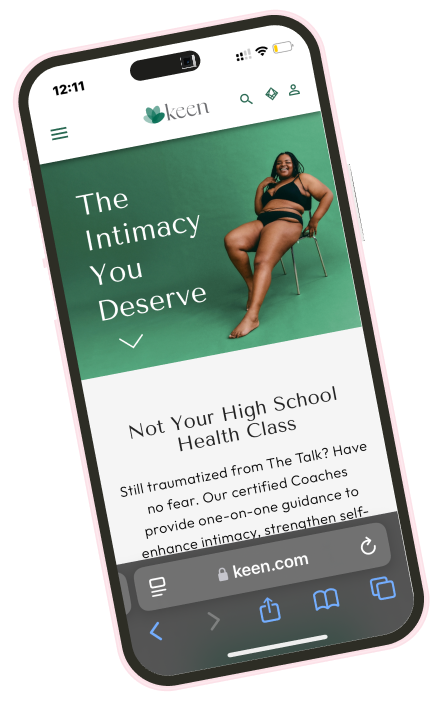
Keen
Expanded Keen beyond psychic services by identifying and designing a new coaching vertical.
Keen had always been centered around psychic services, but there was growing interest in expanding beyond that.
Through research, a clear pattern emerged. People weren’t just looking for answers. They were looking for guidance. Especially around relationships and self-connection.
That shift led to the launch of intimacy coaching as a new vertical.
Role
Lead Researcher & Product Designer
Scope
Research, interaction model, AI-assisted guidance system, MVP strategy
Team
Product Manager, 2 Engineers

Background
Keen has long been known for psychics.
But that wasn’t exactly where the business wanted to stay.
There was a push to expand into new verticals. Ones that felt adjacent. Still personal, still a little unstructured, but offering real value.
So we went looking.
Through research, one thing became pretty clear.
People weren’t just looking for answers. They were looking for guidance.
Mostly around relationships and self-connection.
That’s where intimacy coaching clicked.
It naturally bridged personal growth and relationship support, and made sense for the audience Keen already had.
The Research
I wanted to make sure we weren’t just guessing here.
So I took a multi-pronged approach:
Competitor analysis
What’s already out there, what people are offering, and where things start to fall apart.
Interviews
25 people (ages 25–50, across genders, ethnicities, and sexual orientations) who were familiar with coaching, but not Keen users. This helped us get outside our own bubble.
5 current Keen customers to understand how this might actually land with the existing audience
5 intimacy coaches to learn how they work, where things break down, and what a platform like this would need to support
Goal
Build something that works on both sides.
Because if it only works for coaches or only works for customers, it doesn’t work.


Early Prototypes
& Testing
I started with mid-fidelity wireframes and immediately put them in front of potential users via interviews and usability testing. We focused on the feel of the site—did it inspire trust? Did it make booking a session easy? What was missing? These early insights helped us refine the look, navigation, and feature set.
Feature Development & Approach
-
Several key features emerged from testing:
-
Coach Profiles: High-quality photos, bios with coaching certifications, and intro videos to showcase personality and expertise.
-
Appointment-Based Booking: Unlike on-demand psychic readings, customers expected to book scheduled sessions.
-
Transparent Pricing: Sessions, not minutes—clear costs upfront.
-
Video Chat Integration: A core requirement from both customers and coaches.
-
Customer Reviews & Testimonials: Trust-building elements that encouraged bookings.
This shift in pricing model and scheduling was a major departure from Keen’s psychic offering, giving us an opportunity to experiment with new revenue structures.
Stakeholder Collaboration
Not everyone was immediately sold on video chat or session-based pricing.
So I kept things moving. Regular updates, working sessions, and an internal panel to pressure-test priorities and keep alignment.
The biggest debate was around video.
In the end, the research settled it.
Customer expectations and industry standards were pretty clear. Without video, this wasn’t going to hold up.


High Fidelity
& Brand Alignment
Keen was rebranding while we were building this, so the experience had to evolve with it.
We brought the new visual system into higher-fidelity designs, making sure it felt cohesive without losing clarity or conversion.
Reflections & The Future
Every project teaches you something.
This one made it pretty clear. Research isn’t just informative. It’s persuasive.
Getting alignment wasn’t about debating ideas. It was about showing what the data actually said.
And once that was clear, everything moved faster.
This wasn’t just about launching intimacy coaching.
It ended up shifting how Keen thought about the product.
Video chat and session-based pricing didn’t just live in one corner.
They rippled across the entire platform.
It’s a good reminder. Expanding into something new doesn’t just add a feature. It changes the system.
And that design isn’t just about what you make.
It’s about how you move people toward it.

Role
Lead Researcher & Product Designer
Scope
Research, interaction model, AI-assisted guidance system, MVP strategy
Team
Product Manager, 2 Engineers